Riaño: the eclipse I drove to
Past eclipse The eclipse on this page happened on 12 August 2026. For the next one, on 2 August 2027, start with where to see it, cheapest first →
On 12 August 2026 the Moon's shadow crossed northern Spain at the end of the day, and I drove from Clermont-Ferrand to stand under it. I saw the totality in full, from the high ground above the Riaño reservoir. This page is what that trip is worth to anyone deciding about 2027 — the geometry first, because the geometry is the part I can prove.
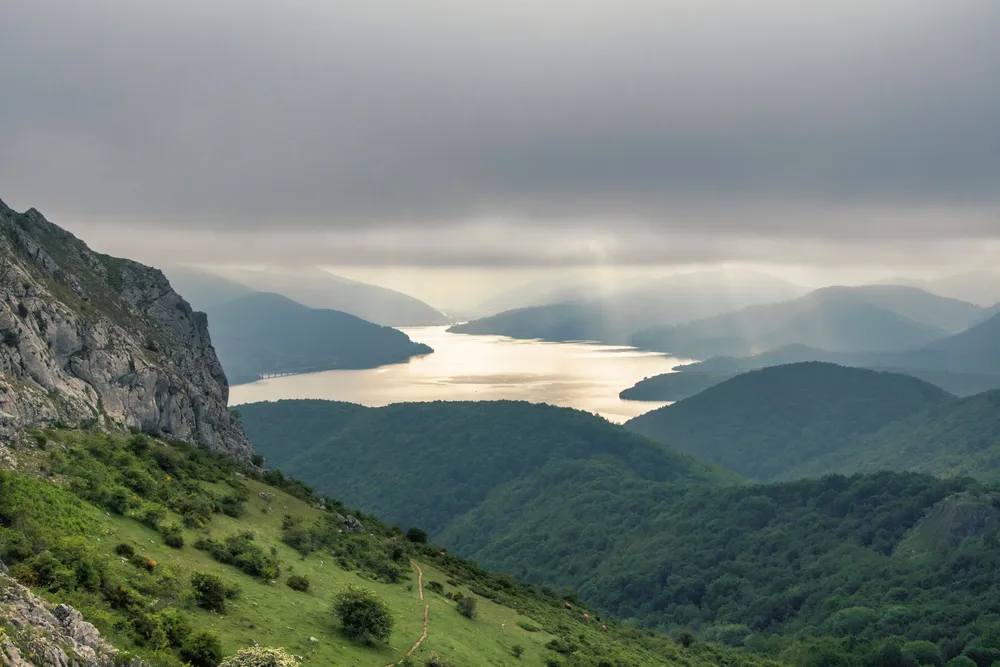
What the sky actually did
1m46s of totality, centred on 20:28:24 local time, with the sun 9.5° above the horizon at azimuth 281.5°. The axis of the shadow passed 0.152 umbral radii away, so this was near the longest duration available that evening rather than a clipped edge.
Nine and a half degrees is the figure that matters, and it is why this eclipse was difficult in a way no forecast showed. At that height the sun is about to go behind something. Not cloud —terrain.
The ridge nearly took it
Before leaving I computed the skyline in the direction of the sun, point by point, off the elevation model. Put beside the oracle's clock, the result is the sharpest thing this trip taught me.
| Where you stand | Sun goes behind the ridge | Against totality 20:27:31 → 20:29:17 |
|---|---|---|
| Riaño, down in the town | 20:28:50 | Loses the last 27 seconds. Clearance 0.08°. |
| Mirador de Valcayo, on the slope above | 20:51:20 | Twenty-two minutes to spare. |
Two hundred metres of climbing is the difference between a whole totality and one that ends behind a mountain while it is still going on. The weather did not decide that, the traffic did not, the booking did not. A contour line did.
The two clocks come from separate computations — the eclipse times from the Besselian reduction, the ridge times from a 40 km terrain profile over EU-DEM. Their solar positions were derived independently and agree to two hundredths of a degree, which is what makes them readable against each other at all.
The route
Nine days, Clermont-Ferrand out and back, with the eclipse on day seven.
| Day | Leg |
|---|---|
| 6 Aug | Clermont-Ferrand → Toulouse |
| 7–8 Aug | Toulouse → La Massana, Andorra. Two nights |
| 9–10 Aug | Andorra → Zaragoza → León |
| 11 Aug | Into the mountains. Scouting Riaño, Cofiñal, Puebla de Lillo |
| 12 Aug | Eclipse day at Riaño, then east to Camaleño and Espinama for the night |
| 13 Aug | Fuente Dé → Potes → the Hermida gorge → the Cantabrian coast → Dax |
| 14 Aug | Dax → Clermont-Ferrand |
Driving times are deliberately missing. I planned them, I did not clock them, and a planned duration published as a measured one is the exact thing this site exists not to do.
What the day was actually like
Owed: what time we left, whether the roads held, where we parked and how far that was from the viewpoint, how many people were there, and what the sky looked like from the ground rather than in the model. I have not written it down yet, and I will not reconstruct it from the plan.
What it cost
Owed, for the same reason. The receipts exist and they are not gathered. The travel folder holds pre-departure estimates only, and an estimate presented as a spend would be worse than an empty table, so this section stays empty until it is filled from receipts.
What this says about 2027
The 2 August 2027 shadow comes back to Spain, at the far end of the country and in the middle of the day. Everything that made Riaño hard stops applying — the low sun, the ridge, the twenty-six seconds. What replaces it is the duration, and the price.
| Riaño, 2026 | The Strait, 2027 | |
|---|---|---|
| Totality | 1m46s | 4m39s at Tarifa, 4m29s on the Rock |
| Sun above the horizon | 9.5°, so the ridge is the risk | High. The ridge stops mattering |
| Cloud, 28 July - 7 August, 2001-2024 | not computed for 2026 | 14.9 % to 18.1 %, clear 80.3 % to 82.2 % |
| The bed, eclipse nights against an ordinary week | not gathered | ×20.9 Gibraltar, ×9.8 Cádiz |
Tarifa gets 4m39s against Riaño's 1m46s — two and a half times as long, on the same side of the same sea, four hours further south. And it is already priced for it: €10,547 for the four eclipse nights in Gibraltar against €505 for the same query a week later, both read on Booking.com on 24 September 2026. That is ten months out.
Jerez, the airport most people would fly into, is inside the path for 1m42s. That is not a mistake worth making twice: the duration climbs the whole way down to the coast.
- Gibraltar — the Rock, the bus that runs today, and the second steepest premium we have measured; only Luxor's is steeper
- Cádiz — the famous name on this coast, and the shortest totality of the ones we have measured
The 2027 lodging figures above: Booking.com, read 24 September 2026. How we measure
Sources
- 2026 eclipse geometry — our own Besselian reduction, from NASA GSFC elements for 2026 August 12. Its acceptance test reproduces five central-line rows of NASA's published path table to 0.1 s of duration and 0.5° of solar altitude, and recovers the greatest-eclipse instant to two seconds.
- Ridge times and clearances — terrain profile over 40 km in three azimuths around the solar azimuth, EU-DEM 25 m elevations, corrected for the curvature of the earth. Computed 2026-08-06, before departure.
- 2027 durations and cloud — the same oracle and the same POWER/ERA5 climatology every destination page here uses; see how we measure.
- The route — the trip's own planning journal. Stages only, no timings.