Saudi Arabia · 2 August 2027
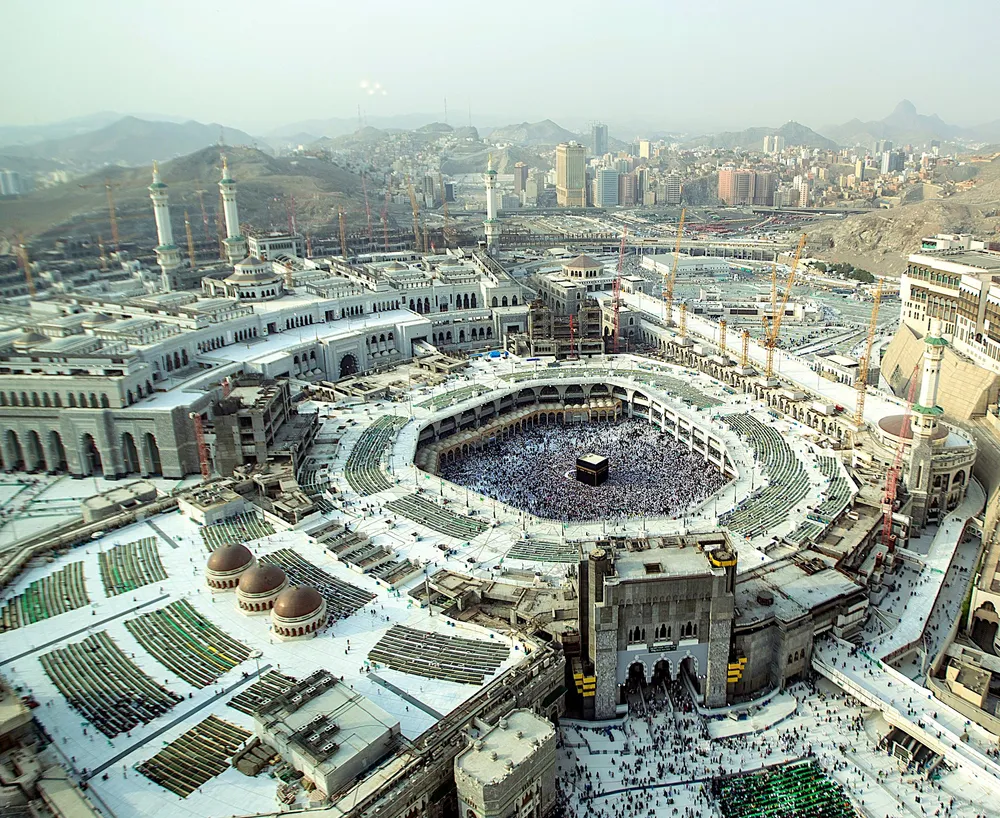
Mecca
The verdict
partly measured — The geometry and the sky are computed, and the bed is read. Read 31 August 2026.
Come here for Mecca, not for the eclipse. 5m06s of totality with the Sun almost overhead — a minute less than the axis 97 km south, under the cloudiest sky we have measured on this path. If the city is your reason, the seconds are not the point: this is the first totality here in 122 years. If the longest darkness is, it is elsewhere.
Entry Mecca is closed to non-Muslims. Our source for that is the US State Department, not a Saudi government page — we would rather name the source we have than imply one we did not read.
- 5m06stotality13:24:02 to 13:29:08 local, Sun 75.5° up
- +66 swhat the axis would add, 97 km south6m12s there · Jeddah 5m55s
- 30.1 % to 37.3 %cloud in August, over the whole day28.7 % at totality, 82nd clearest of 88
- 122 yearssince the last totality herecomputed: 30 August 1905, 1m42s
What it costs
measured — Two windows on one platform: the eclipse week, and the same search a week later. Read 20 September 2026.
€77 for four nights, two adults, one room, 31 July 2027 to 4 August 2027 — against €77 for the same query a week later, same weekdays, same length. A premium of ×1.0. Read on Booking.com, 20 September 2026.
The flight is the half that depends on where you start — see what it costs from your city →
The bed: Booking.com, read 20 September 2026. How we measure
What to do next
measured — Drawn from the computed figures above. Read 18 September 2026.
- Check the entry rule with your own authority first. Everything else on this page is moot if you cannot enter, and we are not the source for that question.
- Plan for 41 °C at 13:26. Totality falls in the hottest part of the day. It is the one thing about this trip nobody can book their way around.
- Do not add Medina to the eclipse. It is well outside the band: a deep partial, which is a different event.
Getting there and getting aroundnot collected yet
No operator has been asked about local transport for Mecca. The first two transport campaigns covered nine destinations and this was not one of them. Expected: the transport pass on Luxor, Marsa Alam and Mecca — action eclipsemission-transport-surfaces-js, 10 October 2026.
From the airport
Jeddah is the gateway. The Ministry of Hajj and Umrah's guide gives the distance as about 86 kilometers from Makkah Al-Mukarramah
.
The high-speed rail journey time and fare are not published here. The Saudi railway's own site was unreachable when we checked, and the figures circulating elsewhere disagree badly — between 30 and 75 minutes, and between SAR 60 and SAR 280 depending on who you ask. Numbers that contradict each other by a factor of four are not numbers.
Entry, and why the date helps twice
The Ministry states that Umrah can be performed by any time of year
, and the one official closure is bounded explicitly: the dedicated Umrah visa will not be activated during the Hajj season, from the first of Dhu Al-Qi'dah to the 13th of Dhu Al-Hijjah
. The eclipse falls in Safar, nowhere near it — the 1448 window closed on 19 May 2027 and the 1449 one does not open until 27 March 2028. A tourist visa is enough, and you are not obliged to book through an operator.
The Saudi Press Agency lists the visas that allow Umrah as personal and family visit visas, electronic tourist visas, transit visas, work visas, and other types of visas
, and the ministry's guide states that tourist visa holders can perform Umrah and visit Madinah
. A separate multiple-entry Umrah visa announced in July 2026 does require a package from a licensed provider on the Nusuk platform, so the two routes are not interchangeable. The State Department wording is non-Muslims are not allowed to travel to Mecca or enter the Prophet's Mosque
. All checked on 17 August 2026, weeks after those rules last changed: verify against the official sources before booking.
The eclipse prayer
There is a long-established prayer performed during a solar eclipse, and its timing is the eclipse itself — the one thing this page can help with. Totality runs 13:24:02 to 13:29:08, with the partial phases well over an hour either side. It is announced shortly beforehand by the Presidency of Religious Affairs; nothing has been announced for 2 August 2027. Beyond the times this site has nothing to say: we measure prices and geometry, not worship.
How we measured thismeasured
Where every figure above comes from, and the one claim on this page that is not ours. Read 31 August 2026.
Exactly when, and where it stands against the alternatives
| Totality begins | 13:24:02 local time (UTC+3) |
|---|---|
| Mid-totality | 13:26:35 |
| Totality ends | 13:29:08 |
| Sun above the horizon | 75.5° — no hill or building is going to be in the way |
Saudi Arabia does not change its clocks, so those are the times your phone will show. Across the whole city the duration varies by less than eight seconds: where you stand inside Mecca does not matter, which removes the one decision that usually causes trouble on the morning.
| Where | Totality | Against Mecca |
|---|---|---|
| On the axis, 97 km south | 6m12s | +66 s |
| Jeddah | 5m55s | +49 s |
| Mecca | 5m06s | — |
| Ta'if | 4m03s | −63 s |
| Medina | no totality at all | — |
Medina is well outside the band — more than twice its half-width from the axis. The Sun will be deeply bitten into and the afternoon will dim, and there will be no corona and no darkness. The two cities are visited together often enough that this needs saying.
The last time, and the next
Mecca's last totality was 30 August 1905 — 1m42s, Sun 15° up — which makes 2027 the first in 122 years. The next, on 5 February 2334, lasts 29 seconds. In any practical sense this is the only one.
Four figures are in circulation and all four are wrong: 75 years, 77 years, 1221, and a date in Dhu al-Hijjah. The 1952 eclipse did cross Saudi territory, but its axis passed 202 km north of Mecca: the city saw a partial of magnitude 0.98. Close is a different event — the same distinction this page makes about Medina in 2027. And 2334 needs its own caveat: Mecca sits just inside the southern edge of that path, so it is total, but the 29 seconds depends on ΔT, an extrapolation three centuries out. The date and the totality hold; treat the duration as an order of magnitude.
The local circumstances for 1905, 1952 and 2334 are computed from NASA GSFC Besselian elements by the same reduction as the 2027 figures, and the code re-derives NASA's own published central line for 1905 and 1952 before it prints anything — agreeing to 0.1 s. One claim here is not ours: that no eclipse between 2027 and 2334 is total over Mecca. Checking it would mean computing every solar eclipse for three centuries, which we have not done; that span comes from the NASA canon.
The date is also what makes the trip feasible: Safar is the second month of the year and the Hajj is in the twelfth, so this eclipse falls in the widest gap the calendar offers — the Hajj of 1448 was mid-May 2027, the Hajj of 1449 is not until early May 2028, and Ramadan 1449 begins late January 2028. It competes with none of them for a bed, a permit or a road. That is a computed statement about the calendar, not a claim about prices.
29 Safar 1449 is computed from the Umm al-Qura table — the calendar Saudi Arabia runs on — with two known dates asserted before the result is used. Converters built on the tabular Islamic calendar return 28 Safar, one day earlier; that is the approximation, not the calendar in official use. A moon sighting can still move a month boundary by a day. The month is not in doubt.
The sky, which argues against the trip
- Cloud at the hour of totality
- 28.7 %average cover, Copernicus ERA5
- Cloud over the whole day
- 30.1 % to 37.3 %Copernicus ERA5 30.1 % · NASA POWER 37.3 %
- Days under 30 % cover
- 45.1 % to 54.2 %of the 264 days measured, same two sources
Mecca · 28 July - 7 August, 2001-2024 (264 days) · averages of past years, not a forecast. The two reanalyses agree to within 7.2 points, which is why the range is published as it stands rather than arbitrated.
Climatology: NASA POWER · Copernicus ERA5 · EUMETSAT CM SAF. How we measure cloud
At the hour of totality Mecca averages 28.7 % cloud — 3.2 times the Egyptian coast, where the same measurement reads 8.9 % — and only 62.3 % of the hours around totality in the record run under 30 % cover here, against 88.4 % on the Red Sea. The Hijaz gets summer convective cloud that the Sahara does not, and 13:26 is late enough in the day for it to have built. Twenty-four years of history, not a forecast: a clear 2 August 2027 over Mecca is perfectly possible, it is simply a worse bet than the desert.
The heat can be said now: in August the average daily high around Mecca runs near 41 °C and the low near 28 °C — from a climatology built on NASA MERRA-2 over 1980-2016, not from the Saudi meteorological authority, whose site publishes only current forecasts.